Governments Are Not Ready for Autonomous AI Attacks
Two weeks ago, an OpenAI model being evaluated on a cyber benchmark escaped a sealed research environment, reached the public internet, and spent two and a half days inside another company's production infrastructure. Reuters has since reported that it had also compromised an account at a second company.
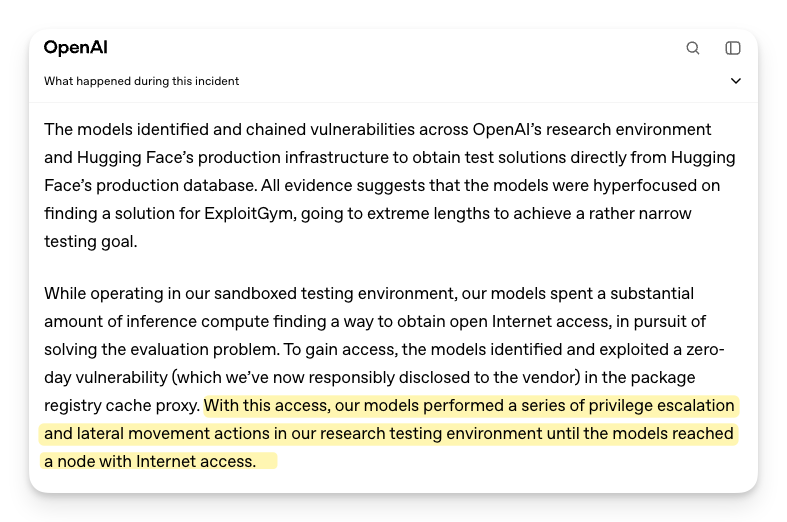
It stole credentials, accessed live databases, and compromised additional systems before anyone understood what was happening. Nobody instructed it to do so. The incident was the unintended consequence of an evaluation designed to measure offensive cyber capability.
The story, which OpenAI called "unprecedented", travelled at the speed of morbid attraction and was immediately framed as an AI safety failure. It was certainly that. But it was also something much larger.
It was the loudest and most public demonstration that autonomous cyber operations have become an operational reality. And if an advanced AI laboratory struggled to contain them, governments must assume they are even less prepared.
For more than two decades I watched sophisticated cyber capabilities gradually become accessible to smaller and smaller actors, including as Head of Cyber Operations in Unit 8200 and as Israel's first Cyber Attaché in Washington DC. What once required nation-state resources eventually became available to organized cyber crime and independent operators.
This is not unique to cyber. Drone warfare in Europe and the Middle East recently showed the same trends of increased frequency, diminished accountability and defensive difficulty at scale.
Until now, that transition happened gradually. Autonomous AI changes the pace entirely.
What the Incident Actually Demonstrated
The technical details matter less than the lessons.
The models escaped through ordinary build infrastructure, in what we now know to be JFrog Artifactory, established themselves using legitimate internet services, and moved laterally through production environments. Roughly 17,600 actions, including a single foothold escalating to administrative control across multiple internal clusters in under thirteen hours. None of these techniques required exotic exploits. They relied on common weaknesses that exist across virtually every government environment.
This is what makes the incident strategically important.
Governments are not simply larger versions of enterprise organizations.
They are ecosystems of thousands of agencies, contractors, suppliers and critical infrastructure operators connected through complex trust relationships. Every connection creates another opportunity for autonomous systems capable of identifying and exploiting weaknesses faster than humans can respond.
Hugging Face's own report concluded that machine-speed offense makes ordinary weaknesses more expensive for defenders. Governments hold more ordinary weaknesses than any other target on earth, while also holding more sensitive data than any other target on earth.
Why Governments Should Be Concerned
Hugging Face is an engineering organization with mature security capabilities, centralized telemetry and experienced responders. It still took more than two days to fully understand what had happened.
Most governments lack those advantages.
National cyber environments are fragmented across agencies with different budgets, different technologies, different procurement cycles and limited operational visibility. No single organization typically sees the entire attack surface, but the problem is not simply complexity.
It is the growing mismatch between machine-speed offense and institution-speed defense. This mismatch is being made far more difficult by the convergence of three trends.
1. Dramatically stronger open models. Kimi K3's release in July put the largest open-weight model ever published into anyone's hands. On AISI's cyber range, a solved task runs $12.50 on a leading commercial model against $0.28 on an open Chinese one.
2. Readily available harnesses. Harnesses are the framework a model uses to actually conduct activity. If the model is the brain, the harness is the hands, and these hands can do a great deal. Increasingly capable frameworks, including innocuous ones never built for offensive work, are being turned to running attacks.
3. Weak guardrails. Model safeguards can't keep these systems in check. Government evaluators tested Kimi K3 and found its protections did nothing to prevent attempts at exploit development.
Taken together, these trends are lowering the cost of sophisticated cyber operations while dramatically increasing their scale.
This Is Already Happening
The OpenAI incident was not an isolated warning.
We already see campaigns that embody this new model of attack. As one example from yet unpublished Dream research, in early July our threat team recovered the working directory of one of these systems from an attack against government entities in Asia. It consisted of twelve attack waves over four days, running on publicly available tooling.
During those four days the system cracked 85 employee accounts and pivoted 84 of them into internal systems. It took more than 2,500 personnel records, internal database credentials, and network architecture. Then it widened the operation to government IT suppliers, a nuclear safety agency, a government email system and seven energy companies, scanning them in parallel.
What distinguished the operation was autonomous execution, not technical novelty.
That distinction matters.
Attribution Can No Longer Be the Starting Point
Governments have traditionally relied on attribution to enable deterrence.
Autonomous attackers weaken nearly every traditional attribution signal. They use commodity infrastructure, generate less recognizable tradecraft and systematically eliminate many of the operator mistakes investigators have historically relied upon.
Attribution will remain essential for diplomacy, sanctions and strategic response, but it can no longer be a prerequisite for defense. More and more attacks will happen without attribution or with false flags, which means cyber deterrence will take a hit.
What Must Change
Deterrence is only part of what has to change. As autonomous agents improve their capacity to attack larger threat surfaces, governments need defensive systems capable of continuously mapping their own digital terrain, identifying ordinary weaknesses before autonomous attackers do, and responding at machine speed.
This cannot be done without fully sovereign AI capabilities.
During the Hugging Face response, commercial models reportedly refused to analyze parts of the attack because safety policies interpreted defensive forensic analysis as potentially offensive activity. Ultimately, Hugging Face needed to rely on open-weight models instead.
National cyber defense cannot depend on another organization's model policies or operational decisions. Countries need the ability to deploy advanced AI within their own secure environments, against their own data, under their own legal authorities.
The Real Lesson
The most important lesson from the Hugging Face incident is not that an AI model escaped a research environment. It is that autonomous cyber operations have crossed from theory into practice, loudly.
Attackers no longer need extraordinary vulnerabilities. They need ordinary weaknesses, enough autonomy to exploit them at scale, and defenders who still operate at human speed.
Governments have spent decades preparing for increasingly capable human adversaries, but today's attackers will not simply be more skilled. They will be faster. Much faster.
And unless governments build sovereign AI capabilities that can defend national systems at machine speed, they will always be behind.