Mustang Panda Uses ASEAN Summit Lures to Target Philippine Government Officials
Weeks before ASEAN leaders met in Manila, a China-aligned attacker was preparing malware disguised as documents for their summit.
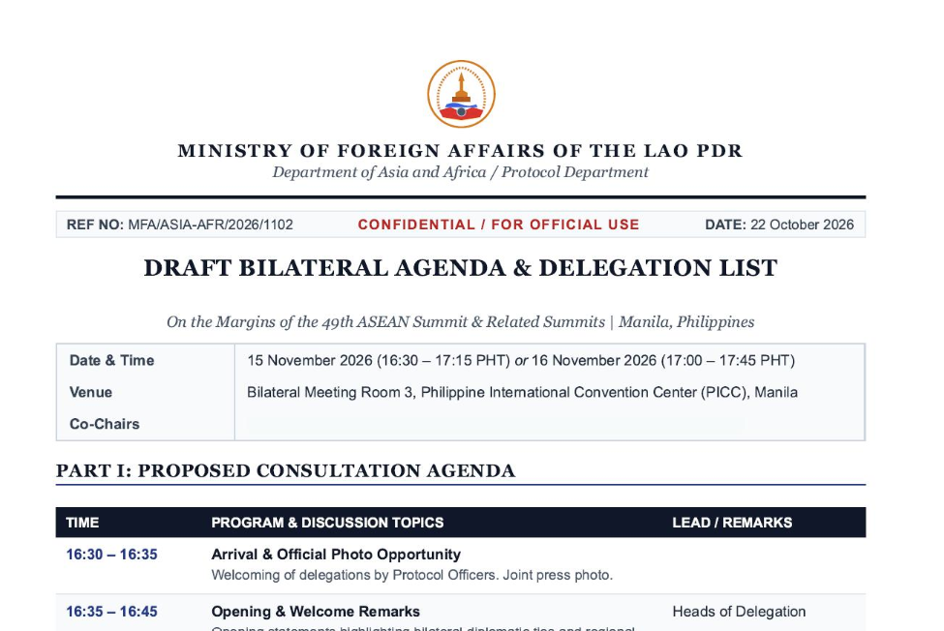
The package impersonated a Laos–Philippines bilateral meeting agenda from the Lao Ministry of Foreign Affairs. It named five officials and referenced plausible diplomatic priorities, requesting that the reader provide confirmation before the summit. Behind it was a delivery chain that installed PlugX remote-access malware while displaying the decoy agenda.
Using Hero, our autonomous cyber research platform, Dream researchers identified the threat and attributed it to Mustang Panda with high confidence. After sharing the findings with our partners, the Philippine National CERT published an advisory citing our research.
However, the Philippines may have been one of several targets. The document’s body named the Philippines, but its metadata still referred to Brunei, suggesting possible reuse across ASEAN countries.
This activity follows Mustang Panda’s established pattern of using diplomatic lures and DLL sideloading to deliver PlugX. For defenders, the challenge is to recognize this familiar tradecraft while tracking changes in the malware and infrastructure, connecting related activity, and translating those findings into detections.
Below, we detail the execution chain, infrastructure, and evidence supporting our assessment.
Delivery and Targeting
The archive, assembled on October 29, was named to resemble a draft bilateral meeting agenda and delegation list for the 49th ASEAN Summit in Manila in November 2026. Its decoy PDF impersonated confidential correspondence from Laos’ Ministry of Foreign Affairs, using official-looking letterhead, an institutional reference number, and the names and titles of five officials to lend credibility to the lure.
The agenda referenced cyber resilience, energy cooperation, and APEC alignment, with a requested confirmation deadline of October 30. These details made the package relevant to protocol offices and foreign affairs teams coordinating summit meetings.
The implant configuration uses "ph" as a magic value, suggesting Philippine targeting, while the PDF’s title metadata references “Lao PDR and Brunei Darussalam.” Together, these suggest broader interest in Southeast Asia, consistent with Mustang Panda’s known regional focus.
The approach is consistent with known Mustang Panda TTPs and is also documented in our earlier PlugX Diplomacy research.
DLL-sideloading and loader updates
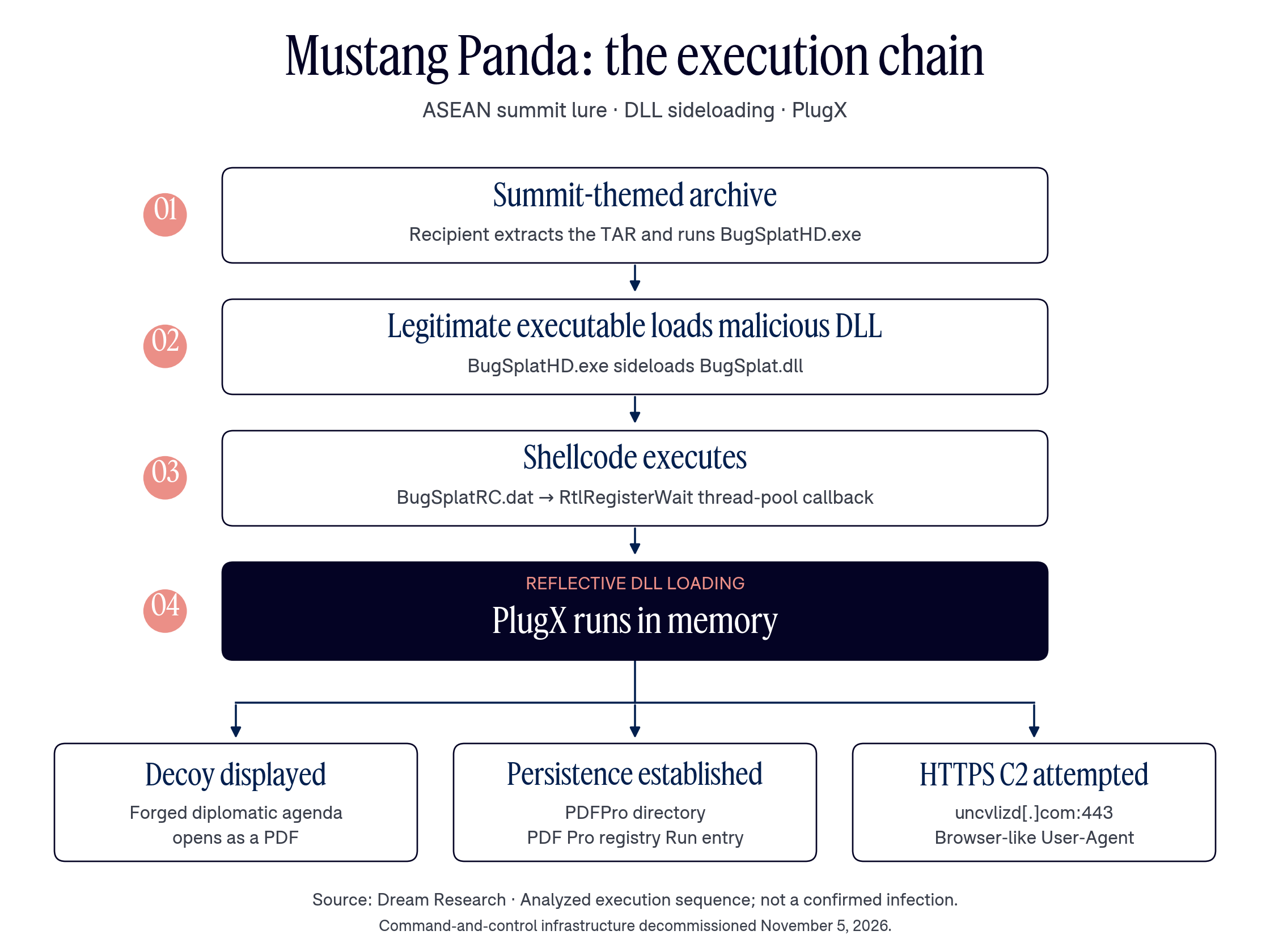
Execution requires the recipient to extract the archive and run BugSplatHD.exe, a legitimate signed Wondershare binary. Viewing the decoy PDF alone is not the execution trigger described here.
- BugSplatHD.exe loads the malicious BugSplat.dll through its import table, a technique known as DLL sideloading.
- The loader reads the shellcode container BugSplatRC.dat using the native Windows APIs NtCreateFile and NtReadFile.
- Shellcode executes through a thread-pool callback registered with RtlRegisterWait.
- The shellcode XOR-decodes an embedded DLL with key 0x06 and reflectively loads it through a SetImageInit export.
- PlugX initializes, establishes persistence, displays the decoy PDF, and attempts command-and-control communication.
Mustang Panda’s abuse of the 64-bit BugSplatHD64.exe–BugSplat64.dll sideloading pair was previously documented by Zscaler in April 2025 to deploy the SplatCloak EDR evasion driver. The activity described here uses the 32-bit BugSplatHD.exe–BugSplat.dll pair to load PlugX. This sample uses ROR-26 hashing for API resolution instead of the previously documented multiply-by-131313 algorithm, with a separate ROL-19 hash in its reflective loader. It executes shellcode through an RtlRegisterWait thread-pool callback. Previously, the loader XOR-decoded a driver with key 0x5a and wrote it to disk; this variant decodes a DLL with key 0x06 and reflectively loads it via SetImageInit.
Infrastructure and C&C
Once running, PlugX copies its components to %public%\PDFPro\ and creates a PDF Pro value under the current user’s registry Run key. It communicates over HTTPS using Cookie-based data exchange. To make its traffic resemble the host’s browser, it reads the installed Microsoft Edge version and incorporates it into the User-Agent string.
The recovered configuration identifies uncvlizd[.]com as the command-and-control endpoint. The domain had previously hosted a legitimate website before expiring. It was re-registered on September 15, 2026, and staging subdomains appeared shortly afterward. This is consistent with Mustang Panda’s documented reuse of expired legitimate domains, likely to benefit from their existing reputation and evade domain-age and trust checks.
The server operated behind Cloudflare from October 27 through November 4 and was decommissioned on November 5.
Indicators of compromise
| Indicator | Observed value |
|---|---|
| Command-and-control domain | uncvlizd[.]com (decommissioned November 5) |
| Installation directory | %public%\PDFPro\ |
| Persistence | HKCU\Software\Microsoft\Windows\CurrentVersion\Run, value PDF Pro |
| Mutex | kepJhBFgE |
| Delivery components | BugSplatHD.exe, BugSplat.dll, and BugSplatRC.dat together |
| Primary delivery archive | 532606ab597ee4f7cd0b0c76ea90e139e601a116bfa355ec1bdbd77566d53e5b |
| Stage 0 (Legitimate signed sideloading host) | 317afaaed74e029f29cf62ff8c141a46d1a2927c0125ef425a1e4687ee3a4df7 |
| Stage 1 (SplatDropper loader) | 687b741e8357c1b823f0ebd1e722de139e94034ebad272d33b4cf6b76c1d1cdd |
| Stage 2 (Shellcode container) | 3c7904c8bfc60e11b1a5d6658502279e267dc83062a0d5220571012b8ff7f590 |
| Stage 3 (PlugX) | 7425b7a56dc9742208fed2d4604f0a3e186e58192b48f4c6a96592ce1d56e49d |
| Decoy PDF | 3b154cef4ecd209c7c7986289cadfaeba7a939bd6c77a74fa099327983ad0bd5 |
| Primary delivery archive name | 03112026_0024_29102026_Draft_Agenda_and_List_of_Delegates_49th_ASEAN_Summit_Bilateral_Meeting_Lao_Philippines.tar |
| Decoy PDF name | Draft_Agenda_and_List_of_Delegates_49th_ASEAN_Summit_Bilateral_Meeting_Lao_Philippines.pdf |
Turning evidence into defensive capability
This activity is consistent with Mustang Panda’s longstanding use of diplomatic events and official documents as phishing lures. The lure and payload configuration support our assessment of Philippine targeting, while the scope of related activity and any successful infections remain unconfirmed.
Hero helped our researchers reconstruct the package’s execution chain, investigate its infrastructure, and develop detections. Publication by the Philippine National CERT makes these findings available to a wider government audience. For national cyber-defense teams, autonomous research can expand investigative capacity and produce evidence and detections that analysts can review, validate, and share.
Use the form below to request the full technical report, including additional indicators, hunting rules and configuration extracting scripts.