AI-Powered Attacks Require AI-Powered Defense
As attacks become AI-powered, defense has to become AI-powered too. Attackers can now hand the tedious parts of an intrusion (credential testing, scanning, enumeration) to agents that run them at scale, read the result of each attempt and choose a different path on their own. Answering that doesn’t take an agent on every control. It takes a change in how defenders investigate and respond.
Security leaders already see it. In October 2026, a16z surveyed 100 CISOs at companies with more than 1,000 employees. Asked to pick their five biggest worries from a list of 16, 55% chose AI-accelerated attacks outpacing their team’s ability to respond, more than any other scenario. Yet only 9% run AI in production for detection engineering and threat hunting. Another 30% are piloting it, and 42% expect to adopt it within 12 months. Leaders know where defense has to go. Most haven’t arrived.
AI gives attackers speed, adaptability and volume
In late October 2026, CrowdStrike reported that a state-linked group had been using ARTEX, an AI-powered penetration-testing framework, against more than 200 organizations since October 17. Planner agents broke each intrusion into tasks. Worker agents ran those tasks along several paths in parallel and switched when one failed, while a human operator steered. Post-exploitation activity was confirmed at nine organizations. Dream’s researchers documented the same pattern earlier this year in a multi-agent framework used against government entities in Asia.
Campaigns like these put three pressures on defenders.
Speed. When the attacker’s next step takes seconds, an investigation that works through evidence one item at a time can finish after the attacker has moved on. The response it recommends then closes a foothold the attacker no longer needs. Bain estimates that lateral movement alone drops from about 168 hours before AI to about three with it. That is an estimate, and it points the same way as what CrowdStrike observed.
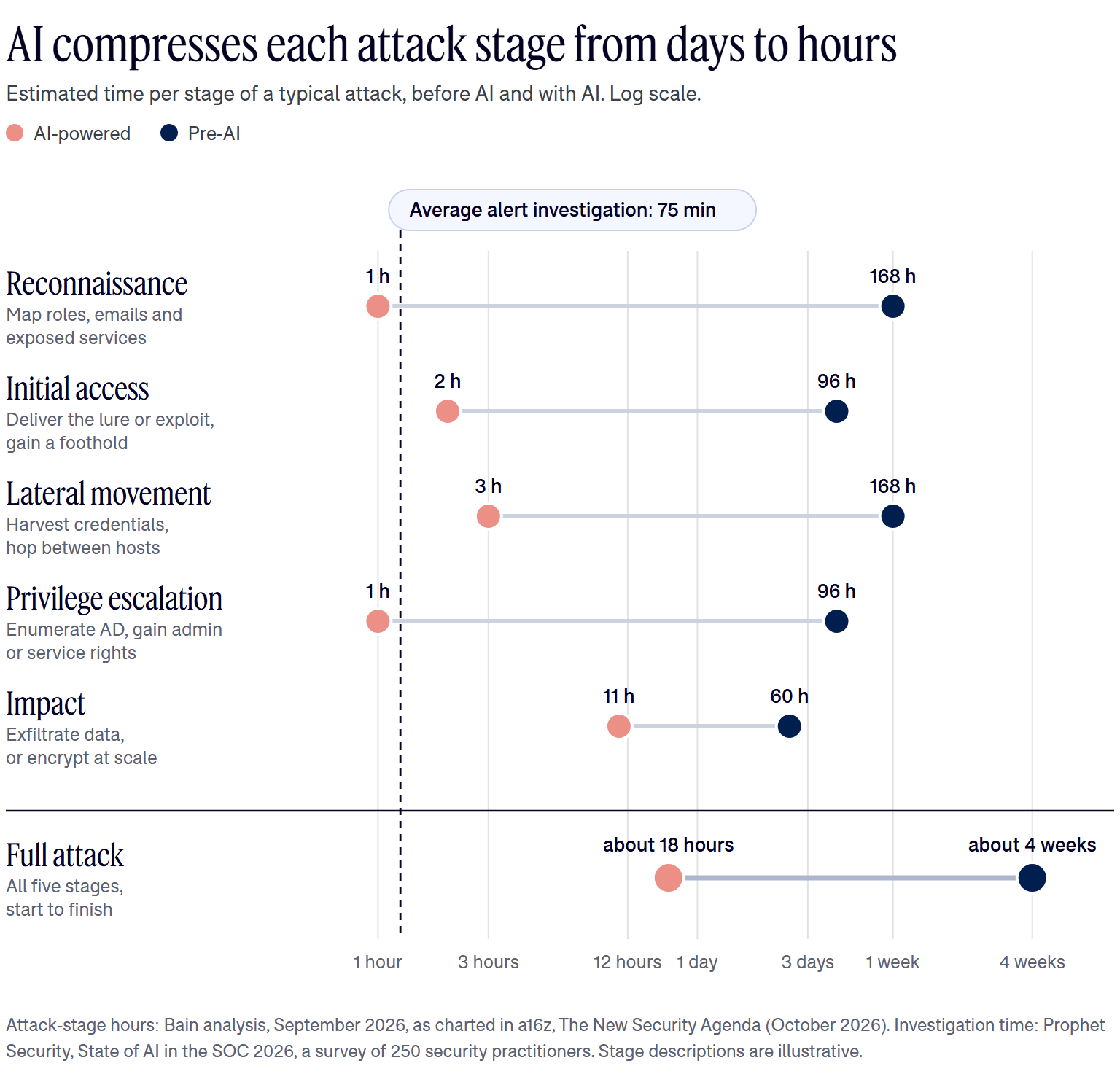
Adaptability. The ARTEX agents weren’t running a script. They tried a path, read the result and chose again. A defender who responds to the first technique they observe is answering a question the attacker has already moved past.
Volume. A small team can now generate activity across hundreds of targets, work that once required a large one. All of it lands in the defender’s queue.
AI-powered defense starts with the investigation
More AI is not the answer. AI must be applied to the work that must keep pace, and that work is investigation. To decide whether an alert matters, an analyst pulls evidence from several systems, reconstructs what happened, works out whether access was attempted or achieved, and judges what the attacker could reach next. Each step is repetitive and depends on the one before it. Attacker speed does its damage here, in the hours it takes to understand what was detected.
Those hours are built into how security operations centers (SOCs) run. In a 2026 survey of 250 security practitioners by Prophet Security, an alert waited an average of 55 minutes before anyone picked it up, and a thorough investigation took about 75 minutes more. Set that against lateral movement that takes three hours. A single alert can use up most of the window, and the verdict still covers one alert while the attacker runs a chain. Analysts need something different: one incident with its full blast radius and context, backed by evidence they can check, and a recommended verdict they can trust or overrule. That is work AI can carry.
One hypothetical: an AI-assisted attack, an AI-assisted investigation
The scenario below is hypothetical, not a real incident or a product demonstration. The third column is the AI’s work, and the analyst decides at the end.
In every row the AI does the same work. It gathers evidence from more than one system, connects it, tests a suspicion against the records and reassesses. No agent acts on its own. The analyst still decides, now from a reconstructed story with the uncertainty visible instead of a queue of isolated alerts. That is AI-powered defense in practice.
The limits are real, and the argument holds
An AI investigation can only connect what it can see. The practical answer is to treat gaps as data: record which signals the investigation looked for and couldn’t find, so that each missing step becomes a question about telemetry. Dream’s investigator is built this way, and the gaps it records shape what we instrument next.
Inferences can be wrong, so a plausible next move is presented as a hypothesis with its test, never as fact. And response actions have consequences, so accountability lives in human review. An analyst either approves the action in the moment or defines in advance the cases where it runs without waiting.
Evaluate the capability, not the label
Most security products now carry an AI label. Three questions separate capability from branding:
Can it investigate connected activity across hosts, users and processes, rather than summarize isolated alerts?
Can it reassess its explanation when the evidence changes?
Can it justify what deserves attention next, with the evidence and the uncertainty visible?
A system that answers yes to all three is doing the work AI-enabled attackers have made urgent. One that answers no is a faster way to read the same queue.
At Dream, every anomaly is investigated before an analyst sees it
This is what we have built toward at Dream. Detection, part of our Sphere platform, is a real-time, model-led reasoning system fed by a lightweight sensor on each endpoint. It starts with an anomaly model that we build in-house and train on each environment it protects, so “unusual” is defined by how that environment behaves rather than by generic rules written to fit everyone.
Every anomaly is investigated in full before anyone sees it. The autonomous investigator runs expert agents, each owning one domain of evidence, and adds what other parts of Sphere already know: who the threat actors are and how they operate, and where this environment's attack paths and exposure lie. Only a story judged malicious becomes an incident, with a timeline, evidence, impact and an agentic response plan. Analysts see incidents, never raw signals.
Dream builds its models in-house and delivers them on-premises as National Sovereign AI, so national systems never depend on a foreign provider’s terms or politics.
ClickFix is a technique we see in the field. It tricks a user into pasting a malicious command into the Windows Run dialog. In a scenario built to mirror it, five signals surfaced in five different parts of the environment: a hidden PowerShell launch, a fetch through a signed Windows binary, a dropped executable, a persistence entry and an outbound connection. Each one alone looked like something an administrator might do. The investigator connected them into one incident, and folded in the same chain when it appeared on a second host. Five alerts became one story.
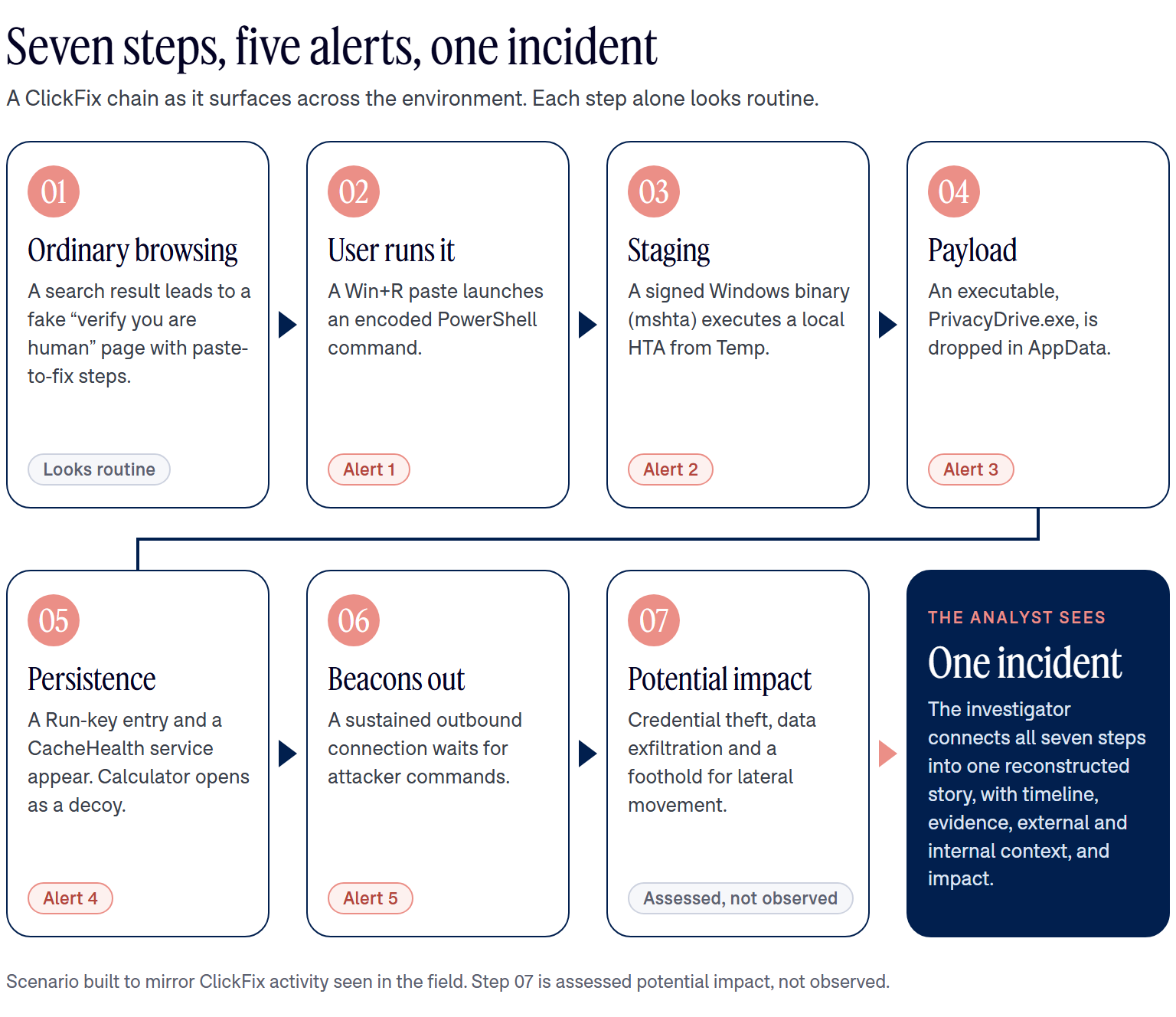
Attackers have begun using AI to work faster, adapt sooner and reach further. Defense has to meet that first in the investigation, where the story is built, and then in the response. For well-understood cases, the response should be set in advance as policy and run at machine speed. Analysts set the bounds instead of approving each step. Sphere supports this with response policies that analysts define once.
Security leaders no longer need to ask whether AI belongs in defense. The question that matters now is whether the AI they are evaluating does the work. Analysts are rarely short of judgment. They are short of time, and a defense that hands them the whole story while the attack is still unfolding gives that time back.